
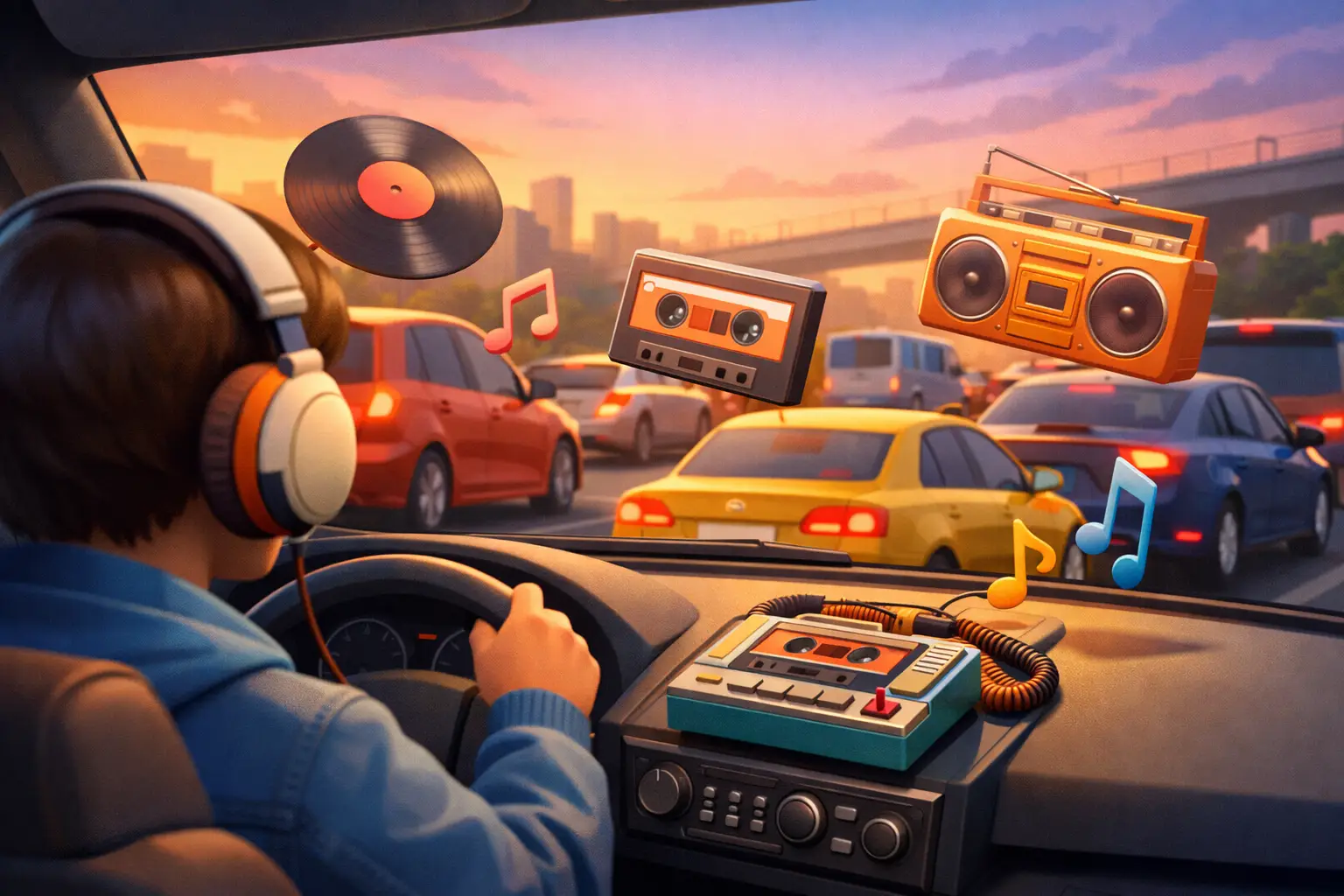
That red brake-light parade is not going anywhere. Your mood, however, has options. The right retro music for commuting can turn a 40-minute crawl into a private dance floor with cup holders, a questionable air-drum solo, and absolutely no need to pretend the morning is going great.
For people who came of age with cassette decks, mall record stores, and the glorious first blast of a song on FM radio, an 80s and 90s commute has a special advantage: the music already knows how to get moving. New wave snaps you awake. Dance-pop gives the highway some pulse. A deep-cut favorite can make even the parking garage feel like you arrived somewhere interesting.
Why retro music for commuting hits differently
Commuting is a strange little zone between who you were at home and who you have to be at work. You are technically doing nothing but steering, waiting, merging, and trying not to make eye contact with the driver singing into a breakfast sandwich. Music fills that gap, and familiar songs do more than provide background noise.
A great retro track gets to the point. The beat lands. The hook arrives. The chorus has a job to do, and it does it with shoulder pads, drum machines, guitars, or all three. That immediacy matters at 7:45 a.m., when a slow podcast intro can feel like another red light.
There is also the memory factor, but nostalgia is only part of the deal. A song you have heard for 30 years can still surprise you when it shows up at exactly the right moment. Maybe the synth line makes you remember a packed dance floor. Maybe the chorus brings back a long-gone car with a stubborn manual transmission. Maybe it simply reminds you that you have excellent taste and always have.
The best commute music does not need to be trapped in the past, either. It should feel alive now. That means choosing tracks with momentum, personality, and enough variety that your ride does not become a loop of the same five obvious hits.
Build your commute around energy, not just eras
The easy move is to throw every song from 1982 through 1999 into one giant playlist and hit shuffle. That can work for a Saturday cleaning spree. For a commute, it can also produce a sleepy ballad right after an adrenaline-charged club track, which is a little like wearing roller skates to a board meeting.
Think instead about the energy your drive needs. Early commuters may want a gentle runway: bright new wave, bouncy pop, and songs with a clean beat before the caffeine has negotiated its terms. If your ride begins in the afternoon after a long shift, go bigger. Bring on punchier dance tracks, weirdly perfect one-hit wonders, and choruses built for shouting at a windshield.
Your route matters, too. A 12-minute city commute needs instant gratification. Pick songs that start strong and keep moving. A 60-minute highway trek gives you room for a few longer cuts, remixes, and songs that build slowly before detonating into something fabulous. If you take public transit, headphones call for a slightly different strategy: crisp basslines, detailed production, and songs that make a crowded platform feel less like a human Tetris tournament.
There is no prize for being overly pure about genre. The fun lives in the overlap. New wave can sit next to freestyle. Dance-pop can follow alternative rock if both songs have a pulse. Even a moody track earns its seat if it helps reset your brain after a brutal day. The question is not, “Does this belong in a museum of the decade?” The question is, “Does this make the trip better?”
Give the first three songs a real job
The opening stretch of your listening matters more than most people realize. It is the musical version of setting the coffee maker before bed. Start with a song that gets your attention without demanding a full-scale rave at the on-ramp. Follow it with something unmistakably upbeat. Then use the third song to establish the flavor of the ride.
That could mean crisp British new wave, American dance-floor pop, synth-heavy club energy, or a left-field favorite that makes you grin before you have even cleared the neighborhood. Once those three tracks land, your commute has a personality.
Save a few monsters for traffic
Do not waste every huge song on open-road cruising. Keep a handful of guaranteed mood changers for the moments when traffic stops, someone merges like they are auditioning for an action movie, or the train announcement says “brief delay” for the third time.
This is where your personal no-fail songs belong. Not necessarily the songs everybody expects. The strongest traffic busters are the ones that get you every time, whether that is a giant singalong, a bass-driven dance cut, or a gleefully odd new wave track that radio forgot but you never did.
Let a human curator surprise you
Algorithms are decent at noticing that you listened to one song. They are less reliable at understanding why you loved it. Was it the sharp rhythm guitar? The attitude? The fact that it played at a party in 1987 where everyone wore too much hairspray? An algorithm may respond with 40 nearly identical recommendations and call it a day.
A real DJ can connect the dots differently. One great song can lead to a familiar favorite, then a killer album track, then a request from another listener that sends you down a whole new memory lane. That surprise is part of what makes radio feel like company instead of software.
Dance Your Ass Off Radio is built for that kind of commute: high-energy 80s and 90s new wave, dance, and pop with DJ Bueller steering clear of the bland, predictable lane. Check what is playing, see recent songs, throw in a request, and let someone with an actual point of view supply the soundtrack. Your route may be the same, but the ride does not have to be.
Keep the commute fun without making it chaotic
Energy is good. Sensory overload is not. If you are driving, avoid turning every morning into a full-volume test of your speakers and nervous system. The goal is alert, entertained, and ready to arrive – not rattled by a 12-inch remix at a volume normally reserved for aircraft carriers.
Give yourself some contrast. After several high-octane tracks, a sleek mid-tempo song can keep the set from becoming one long blur. A funny, quirky selection can also work as a palate cleanser. The best stations and playlists understand pacing. They know that every song does not have to be the loudest song in the room to earn its place.
It also helps to make your music easy to reach before the wheels move. Queue your station or playlist while parked. Keep the phone secure and use your car controls, voice commands, or transit-friendly headphones. A perfect throwback track is not worth fumbling for at a busy intersection.
Make the ride yours
The best retro commute has a few signature rituals. Maybe Friday means extra dance tracks. Maybe rain calls for darker synths and dramatic vocals. Maybe your first song after a rough meeting is always the same defiant anthem. These tiny habits give an ordinary trip some structure, and they make the music feel personal instead of disposable.
Leave room for requests and rediscovery, too. If a song pops into your head after years away, chase it down. If a forgotten artist shows up and makes you wonder what else they recorded, follow that thread later. Music collecting is not just about owning the biggest hits. It is about finding the tracks that still light up a room, a kitchen, a treadmill, or a bumper-to-bumper stretch of interstate.
Tomorrow’s commute will probably still include construction cones, a slow left-lane driver, and at least one person who thinks turn signals are classified information. Give it a beat anyway. Put on something that makes your hands tap the wheel, your brain wake up, and the road feel a little less like lost time.