
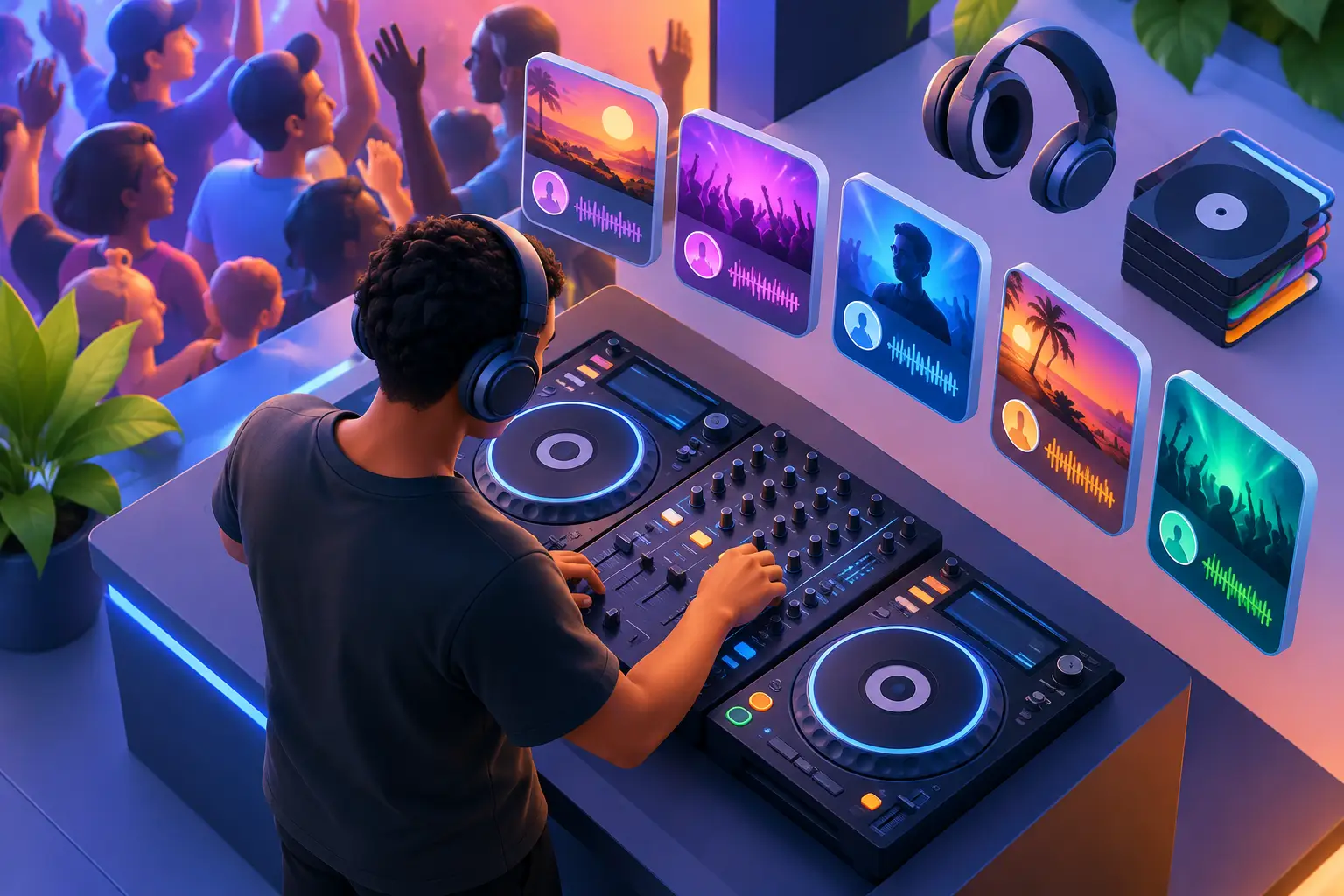
A great segue still beats a perfect spreadsheet. That is the real story behind DJ curation trends right now: listeners have spent years swimming through endless catalogs, and many are ready for somebody with taste to grab the controls. Not somebody chasing whatever an app predicts will hold attention for 22 seconds. Somebody who knows that the right 1984 new wave curveball can make a commute, a workout, or a kitchen-cleaning session feel like Friday night.
For fans of dance, pop, and new wave, curation is not about being told what is popular. It is about being reminded that the tracks you forgot, skipped, taped off the radio, or wore out on cassette still have a pulse. The best curators make familiar songs hit harder and give lesser-played gems a legitimate shot at becoming your next obsession.
DJ Curation Trends Are Going Human Again
Algorithms are useful. They can surface a song adjacent to one you already love, and they never need coffee. But they also tend to confuse similarity with chemistry. A playlist built only on data can be technically correct and completely lifeless.
Human DJs are pushing back by programming with context. They know the difference between a song that belongs on a late-night drive and one that needs a packed room, a cold drink, and questionable decision-making. They can hear when three big choruses in a row become exhausting, or when a left-field synth-pop track is exactly what resets the room before the next banger lands.
That instinct is becoming more valuable, not less. People do not simply want more music. They want fewer bad choices. They want a station or set that feels like a sharp friend took over the stereo and said, “Trust me, this one is next.”
There is a trade-off, of course. Human curation is subjective. You may not love every pick, and that is part of the deal. A real point of view has edges. If every song pleases every listener, the result is usually wallpaper.
The Deep-Catalog Revival Has Real Legs
The same giant hits have earned their place. Nobody needs to apologize for cranking “Blue Monday,” “Holiday,” or “Take On Me” when the moment is right. But a healthy dance library cannot live on 30 songs that have been played into the earth’s core.
One of the strongest DJ curation trends is the return of deep catalog cuts: tracks that had club life, regional radio love, soundtrack placement, or a devoted fan base, but never became permanent corporate-radio furniture. These are the songs that make listeners lean toward the speaker and ask, “Wait, who is this?” Sometimes they know the artist but not the track. Sometimes they have not heard it since 1987. Either way, that spark matters.
For 1980s and 1990s music fans, digging deeper is not about being obscure for bragging rights. It is about restoring range. The era had glossy pop, icy electronic experiments, post-disco grooves, freestyle, Hi-NRG, alternative dance, house crossovers, and wonderfully strange one-hit detours. A good curator lets that variety breathe.
The trick is pacing. Too many unfamiliar tracks can make a listener reach for the skip button. Too many obvious tracks can make the station feel like a mall playlist with better hair. The sweet spot pairs a known favorite with a rediscovery, then follows it with something that makes emotional and rhythmic sense.
Recognition Is a Tool, Not the Whole Set
Smart programming uses recognizable records as anchors. A massive chorus can pull people in, while a buried album cut or overlooked 12-inch mix keeps the experience from getting stale. That balance also respects the listener. It says, “Yes, we know why you came. We also know you have better taste than a greatest-hits loop gives you credit for.”
Mood Programming Is Replacing Lazy Genre Labels
Genres still matter, especially to collectors and longtime fans. But listeners increasingly choose music based on what they are doing and how they want to feel. “New wave” can mean anything from dark, angular synths to bright pop hooks. “Dance” can mean euphoric, gritty, romantic, dramatic, or all four before lunch.
That is why successful DJs are programming energy arcs instead of dumping songs into genre buckets. A workday stream might begin with upbeat tracks that keep the brain moving without demanding full dance-floor commitment. A Friday-night run can turn up the drama, the bass, and the hands-in-the-air moments. A party set needs recognizable entry points, but it also needs surprises before the room gets comfortable.
This does not mean every block needs a cute label and a marketing meeting. It means the person choosing the music has a feeling in mind. Is this stretch flirtatious? Nervy? Neon-lit? Pure release? Listeners may not describe it that way, but they feel the difference.
Requests Are Becoming Part of the Programming Conversation
The request button is not a nostalgia gimmick. It is one of the best ways to turn passive listening into a real relationship. When listeners can ask for a song, watch recent plays, and see what is getting traction, the station becomes a living music community rather than a sealed-off jukebox.
That does not mean every request should air instantly. A DJ has to protect the flow. Dropping a slow heartbreak ballad into a peak-energy dance run because one person asked nicely is how a great set gets whiplash. But requests reveal patterns: songs people miss, artists with loyal fans, regional favorites, and catalog corners worth exploring.
The best approach is responsive rather than obedient. A request can inspire a themed run, lead to a better remix, or open a door to three related tracks the listener did not know they needed. At Dance Your Ass Off Radio, that spirit is the fun of it: listeners bring the memories, and DJ Bueller brings the timing.
Shorter Attention Spans Need Better Openings, Not Shorter Songs
Yes, people skip quickly. Yes, the first few seconds matter. But the answer is not to treat every song like disposable social content. Many classic dance records take their time. They build tension, establish a groove, and earn their payoff.
A skilled DJ can help those records survive modern listening habits by placing them well. Put a slow-burning track after a familiar peak, introduce it with a compelling transition, or choose a mix that gets to the pulse faster. The song does not need to be chopped into pieces. It needs a reason to be there.
This is where radio-style curation has an advantage over random shuffle. The listener is not evaluating each song in a vacuum. They are riding a sequence. When the sequence is good, patience becomes pleasure.
The New Cool Is Having a Point of View
For years, music services sold the fantasy of infinite personalization. Now, the more appealing idea may be selective personalization: a trusted voice, a defined lane, and enough listener input to keep the station from becoming a museum exhibit.
That is especially true for retro-focused dance programming. The goal is not to recreate 1986 with museum gloves on. It is to make those records feel dangerous, joyful, and alive in a 2026 kitchen, car, office, or backyard party. A brilliant old song does not need to be treated like an artifact. Turn it up and let it do its job.
The next time a deep cut catches you off guard, do not just ask what year it came out. Ask why nobody has been playing it loud enough. Then send the request, dust off that old gem, and keep moving.