
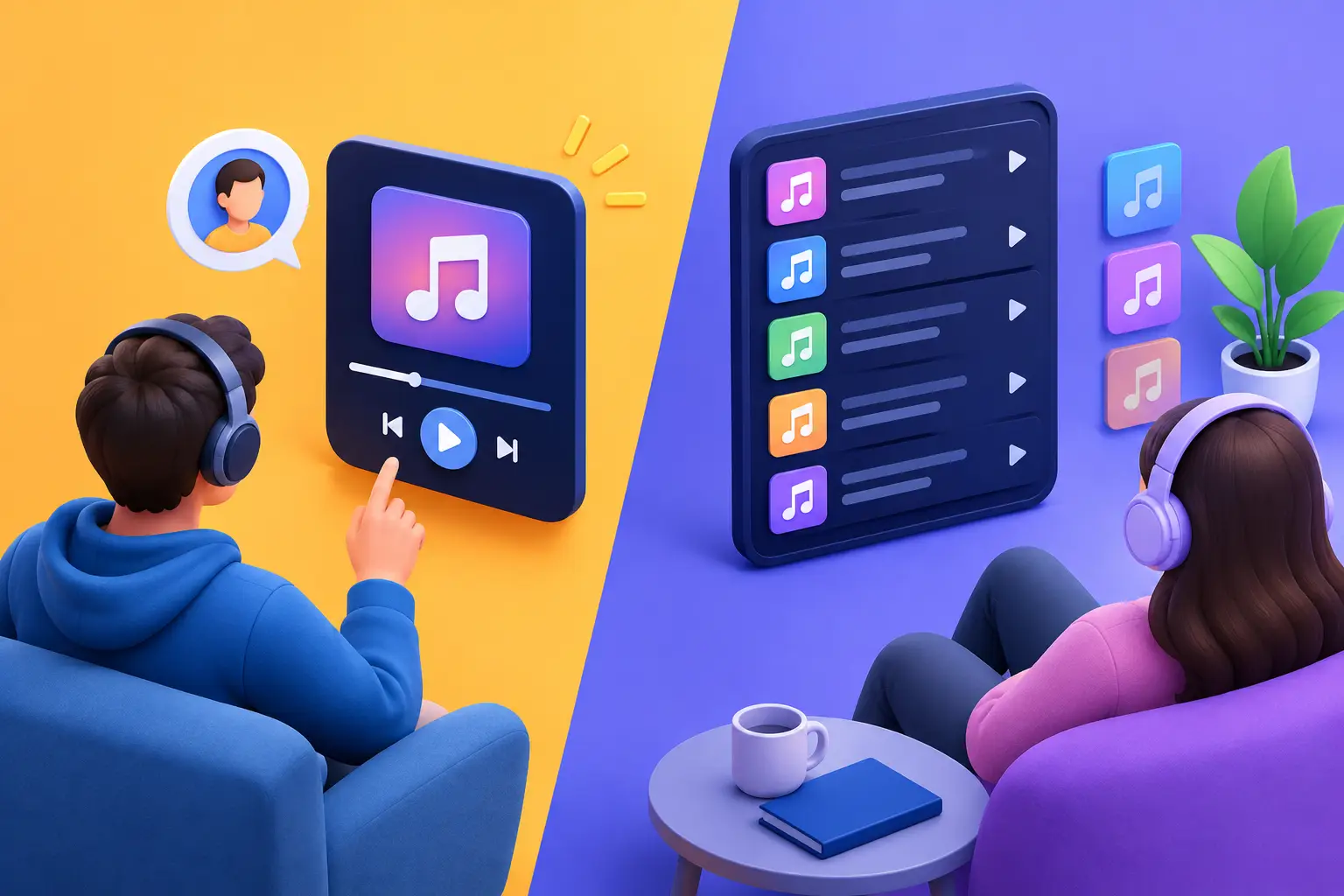
A playlist can keep the beat going. A request can change the whole room. That is the real difference in song requests versus playlists: one serves up a prebuilt sequence, while the other gives listeners a hand on the steering wheel. When you hear your song land at exactly the right moment, it does not feel like background audio. It feels personal.
For fans who still get a jolt from the opening synth line of an old favorite, that distinction matters. We are not talking about choosing between convenience and chaos. We are talking about whether music is something that happens near you or something you get to be part of.
Song Requests Versus Playlists: The Big Difference
Playlists are built for predictability. You choose a mood, artist, decade, or activity, press play, and let the app do its thing. That can be perfect for a quick workout, a flight, or those days when your brain has already made enough decisions before 9 a.m.
But playlists are generally designed around patterns. If you played one familiar 1980s hit, the algorithm may offer the same handful of familiar hits again, just in a slightly different order. It is efficient. It can also get painfully safe.
Song requests work differently because a real person is behind the choice and a real audience is behind the energy. A request might come from someone cleaning the garage in Ohio, driving home in Arizona, or reliving a college dance-floor memory in New Jersey. Suddenly, a track is not merely “recommended.” It has a reason for being there.
That does not mean every request belongs in every set. A good DJ is not a human jukebox with no brakes. The magic is in reading the station’s identity, protecting the flow, and finding the moment where that left-field new wave gem makes total sense. A request becomes better when it is placed with intention.
Why Playlists Start to Feel Predictable
The strongest playlist is still a frozen idea. Even when an app refreshes it, the system is usually reacting to data: skips, repeats, listening habits, popularity, and genre labels. Data can spot a pattern, but it cannot always understand the strange joy of hearing a song you have not thought about since 1987.
That is especially true with dance pop and new wave. These catalogs are full of songs that do not fit neatly into one box. A track may be too synthy for a mainstream pop list, too bright for a darker alternative list, and too deep-cut for a generic “’80s Party” mix. Yet put it between the right songs, and it absolutely smokes.
A playlist also has no sense of occasion. It does not know that it is Friday afternoon, that you are painting the kitchen, or that your friend just texted, “Remember this one?” It can deliver a song. It cannot share the wink.
There is a place for playlists, of course. They are great for a tightly planned event, a specific workout pace, or a no-fuss soundtrack when you want the music to stay out of the way. The trade-off is that staying out of the way is exactly what music should not always do.
A Request Has a Story Attached
When listeners request a song, they are often asking for more than three or four minutes of music. They are sending up a flare: “This one still means something to me.” Maybe it was the song from a first apartment, a roller rink, a road trip, a breakup, or the one that made a bad haircut feel like a bold lifestyle choice.
That story adds weight, even if nobody says it out loud. Requests turn a station into a shared space where listeners can recognize each other through the music. You may not know who requested that infectious dance track, but you understand why they needed it. You wanted it too.
At Dance Your Ass Off Radio, that shared energy is the point. The station can keep the party moving while still leaving room for the listener who remembers the killer B-side, the club remix, or the underplayed single that deserved a much bigger life.
The best requests also challenge a curator in a good way. They encourage the DJ to look beyond the automatic choices and revisit the corners of a music collection that deserve daylight. Sometimes the song that gets the biggest reaction is not the obvious anthem. It is the one that makes people say, “Oh wow, I forgot how much I loved this.”
The DJ’s Job Is More Than Pressing Play
There is a common myth that human-curated radio is less precise than an algorithm. In reality, a good DJ is making constant decisions that software often misses. Does this song lift the momentum or flatten it? Has the audience heard too much of this artist lately? Is there a deeper cut that scratches the same itch without repeating the usual classic?
That is curation. It is taste, memory, pacing, and a little mischief.
A DJ can recognize that two songs from different corners of the 1980s belong together because their bass lines, attitude, or drum programming create the same charge. A playlist engine may see different genres. A music fanatic hears a transition waiting to happen.
Human curation also creates a station personality. You are not listening to a neutral machine that wants to maximize session time. You are hearing somebody make a case for the songs. Even when you do not agree with every pick, there is a point of view. That gives a station flavor, and flavor is why people come back.
When a Playlist Is Actually the Right Call
Let’s not throw playlists out with last season’s leg warmers. They solve real problems. If you are hosting a dinner party and do not want surprises, a carefully built playlist offers control. If you are training for a race, a steady BPM can be useful. If your office needs low-key sound without listener participation, a set list is easier to manage.
The question is whether control is what you want from that listening moment. If it is, make the playlist. Build it well. Add enough variety that it does not sound like a retail store looping the same 24 tracks until morale collapses.
If you want discovery, connection, and the occasional wonderful curveball, requests and DJ-led programming have the edge. You are trusting someone to bring the right energy, not simply to repeat what you already proved you like.
How to Make Better Song Requests
A great request is specific but not demanding. Give the DJ the song title and artist, then let them work it into the flow. If there is a memory behind it, share it when the station has a place for comments. Short is fine. “This got me through sophomore year” says plenty.
It also helps to request with the station’s sound in mind. If the station thrives on high-energy new wave, dance, and pop, ask for songs that live in that neighborhood. That does not mean every selection has to be a chart monster. In fact, a smart deep cut can be the most fun request in the pile.
Avoid treating requests like an emergency broadcast system. Repeating the same title over and over will not make it arrive faster, and it can crowd out other listeners. The best request culture has give and take. You ask for your favorite, then stick around to enjoy what somebody else loves.
Let the Music Surprise You Again
There is nothing wrong with having a comfort playlist. Everybody needs a reliable set of songs that gets the coffee brewing, the treadmill moving, or the housework done. But do not let convenience turn your music life into a loop.
Make a request once in a while. Check what has played recently. Pay attention to the songs that make you stop mid-task and say, “Wait, turn that up.” Those are the moments a playlist cannot schedule, and they are a very good reason to keep listening with your ears open.